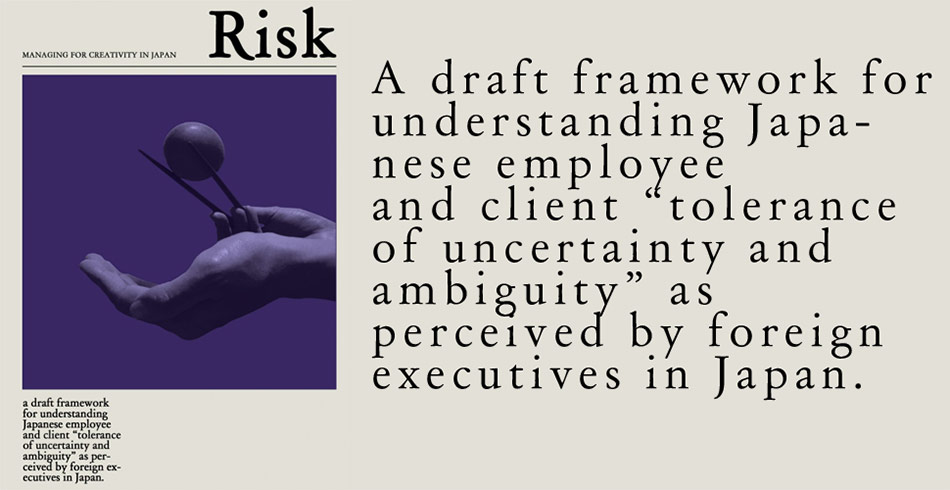
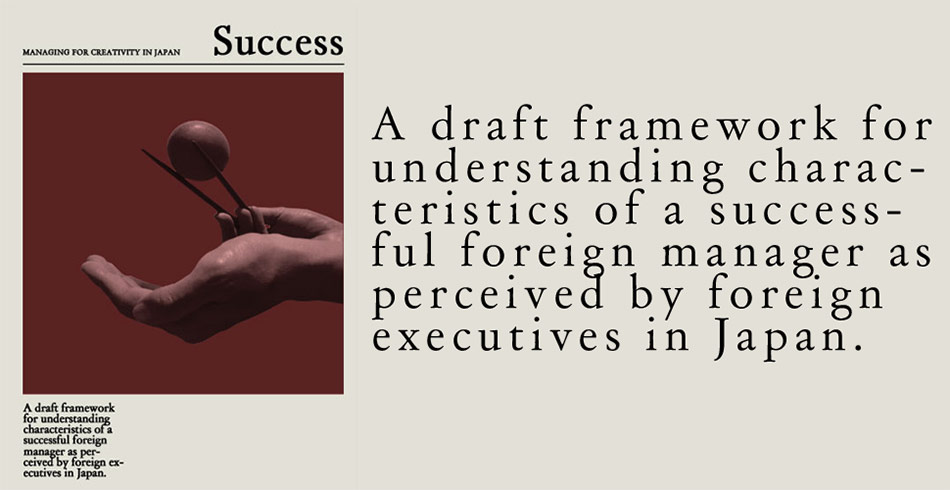
“You have to like working in Japan to be successful, you have to like Japanese people, and part of that comes through understanding things and not finding it frustrating. If you constantly find everything they do totally frustrating you probably just don’t get why they are doing it. This is a factor of both cultural awareness and also personal characteristics. You have to be a bit of a fan of the culture I think, with an open mind and tolerance for different ways of doing things. High tolerance for ambiguity also helps – working within the big picture without understanding it all. You really have to be able to work within shades of grey in Japan because you often don’t know exactly what is going on behind the scenes, no matter how long you have been here.”
****************************************************
This post is part of a series of excerpts from interviews with foreign executives in Japan, focusing on creativity. Excerpts have been edited for confidentiality.
We’d love to hear your thoughts and experiences in relation to this topic. Please feel free to comment directly on this site or get in touch at chris@a-small-lab.com (Chris Berthelsen)
All content on this IDEAS and DISCUSSION blog is provided by a-small-lab under a Creative Commons Attribution-Noncommercial-No Derivative Works 3.0 Unported License: You can SHARE this content as long as you CITE this work, and TELL US about your work (and send us a copy or link!). See Creative Commons for more detail
“I think it is important to observe and to listen. Not just listen. I think that’s relevant everywhere but people aren’t very vocal here – 60% of communication is unsaid. So 60% of everything the Japanese people do is non-verbal. It’s the itch of the nose or the crook of the head – that’s what you’re looking for. You wouldn’t pick up on that if (a) you didn’t understand Japanese culture and (b) you were listening on a tape-recorder. For example, if you ask a consumer what they think about something they might say “it’s OK” but they will have done something else which will tell you that it’s not OK. So you definitely you need their opinions because that’s how you innovate (by understanding insights) but they are never going to tell you what you want so you need understand what their problems are. We go into a lot of consumer homes, go in and see their problems….”
****************************************************
This post is part of a series of excerpts from interviews with foreign executives in Japan, focusing on creativity. Excerpts have been edited for confidentiality.
We’d love to hear your thoughts and experiences in relation to this topic. Please feel free to comment directly on this site or get in touch at chris@a-small-lab.com (Chris Berthelsen)
All content on this IDEAS and DISCUSSION blog is provided by a-small-lab under a Creative Commons Attribution-Noncommercial-No Derivative Works 3.0 Unported License: You can SHARE this content as long as you CITE this work, and TELL US about your work (and send us a copy or link!). See Creative Commons for more detail
“I think that compared to someone who is going to bully people into doing what they want them to do, being open to listening and exploring and really trying to understand is the key to success. How they embrace the culture is important. I know people that go from their home to their office to the Tokyo American Club to a few restaurants in Roppongi or Nishi-Azabu and then home again and they never really understand Japan. They complain about how not everybody speaks English and how not all signs are in English. Clearly they are here because their company made them come here, or they felt that it would be “curious” or a “good experience” for a couple of years. Compare these people to those that come here and either see the bigger picture of what they are trying to do for their business or are genuinely interested in Japan.
(CB: So with a given head office, those two type of people would go about their work differently of course and have different results…..)
I think so. Of course, sometimes consummate bullies who are the CEOs or top management of companies can still get good results because they just force people to do things. But when they leave there is a trail of damage that the next guy has to come in and clean up. So it’s not really success in the long term. It’s a selfish result and when I say selfish I don’t necessarily mean that they are trying to be mean on purpose. Maybe the pressure that is put on them by head office is forcing them the act in a certain way.
(CB: And is this something that is particular to Japan or something you have witnessed with ex-pats in other countries too?)
Good question. People that I know that have gone say, from America to the U.K. or the U.K. to America have also found a world of difference. So I do think that yeah, there are cultural risks wherever you go but at least in other cases the language is the same and there are a lot more cultural cues which can help people to adjust and relate and get by faster. When you come to Japan from the West there are no cultural signposts (or physical signposts) to help you. I remember the first time I moved here I was living in Daikanyama and I wanted to go see a movie. I tried and I couldn’t find a movie theater in Shibuya and I actually went home in defeat. The next weekend, I was so pissed off at myself that I went back and did it again and I found it and even though the movie was terrible I felt like Rocky at the top of the steps you know – “I did it! I found my way!” – So regardless of whatever ex-pat or academic safety net you have it is still like being on another planet for a while until you find your way. Much more so I think than moving from New York to London or Singapore to Auckland, for example.”
****************************************************
This post is part of a series of excerpts from interviews with foreign executives in Japan, focusing on creativity. Excerpts have been edited for confidentiality.
We’d love to hear your thoughts and experiences in relation to this topic. Please feel free to comment directly on this site or get in touch at chris@a-small-lab.com (Chris Berthelsen)
All content on this IDEAS and DISCUSSION blog is provided by a-small-lab under a Creative Commons Attribution-Noncommercial-No Derivative Works 3.0 Unported License: You can SHARE this content as long as you CITE this work, and TELL US about your work (and send us a copy or link!). See Creative Commons for more detail