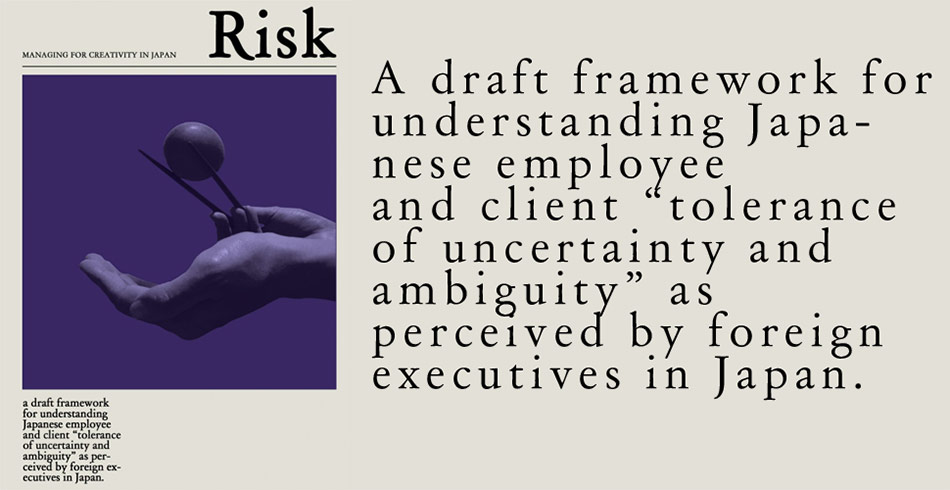
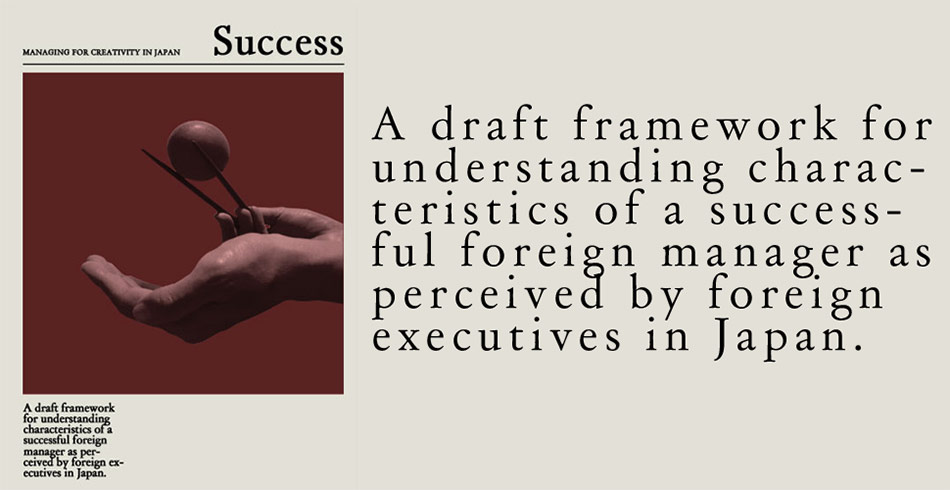
There is a real strength to Japanese culture, as opposed to Singapore which is very Western, understanding and open. This is a very closed society and that gives it strength – I see it as a real privilege to be able to be a part of it. Previously i might have found it complicated or irritating but now it is a privilege because I know that I am part of a very small group of people that live here. We are a real minority here and the people have opened their hearts and their country to us – that’s an honour. This cultural strength means that you can’t just get along with blinkers, and live in your own little Western world – in Singapore I could go to the supermarket and get whatever I wanted but when I go to the supermarket here I can’t even get basil half the time.
“I think it is important to observe and to listen. Not just listen. I think that’s relevant everywhere but people aren’t very vocal here – 60% of communication is unsaid. So 60% of everything the Japanese people do is non-verbal. It’s the itch of the nose or the crook of the head – that’s what you’re looking for. You wouldn’t pick up on that if (a) you didn’t understand Japanese culture and (b) you were listening on a tape-recorder. For example, if you ask a consumer what they think about something they might say “it’s OK” but they will have done something else which will tell you that it’s not OK. So you definitely you need their opinions because that’s how you innovate (by understanding insights) but they are never going to tell you what you want so you need understand what their problems are. We go into a lot of consumer homes, go in and see their problems….”
****************************************************
This post is part of a series of excerpts from interviews with foreign executives in Japan, focusing on creativity. Excerpts have been edited for confidentiality.
We’d love to hear your thoughts and experiences in relation to this topic. Please feel free to comment directly on this site or get in touch at chris@a-small-lab.com (Chris Berthelsen)
All content on this IDEAS and DISCUSSION blog is provided by a-small-lab under a Creative Commons Attribution-Noncommercial-No Derivative Works 3.0 Unported License: You can SHARE this content as long as you CITE this work, and TELL US about your work (and send us a copy or link!). See Creative Commons for more detail
“One major obstacle is that you have to speak the language. If you can’t speak Japanese you better be really good at what you do. You need good personal introductions. You need to prove yourself quite quickly. You need to be there. Also, I think that foreign companies are still viewed with suspicion. There is still a sense of ‘what can someone as a foreigner tell me about Japan?’ I think that is a problem. As a foreigner myself, if another foreigner came up to me and said ‘I’m a marketing consultant, I can do this that and the other’ I would say ‘Well what do you know about Japan?…are you Japanese? ‘no’ Well do you speak Japanese ‘no’….well then what are you basing this insight on?
I don’t speak fluent Japanese but you need to at the very least be able to navigate around an office and understand how protocol and meetings work. At least play the game. You can’t not speak the language and not play the game either. You have to know what you’re doing, for example, turning up for meetings. You might think that the meeting is pointless and that you don’t need to go along but you do…they want to see your face. That’s important. In the West you might get away with not turning up to meetings…you really do have to play the game here.”
****************************************************
This post is part of a series of excerpts from interviews with foreign executives in Japan, focusing on creativity. Excerpts have been edited for confidentiality.
We’d love to hear your thoughts and experiences in relation to this topic. Please feel free to comment directly on this site or get in touch at chris@a-small-lab.com (Chris Berthelsen)
All content on this IDEAS and DISCUSSION blog is provided by a-small-lab under a Creative Commons Attribution-Noncommercial-No Derivative Works 3.0 Unported License: You can SHARE this content as long as you CITE this work, and TELL US about your work (and send us a copy or link!). See Creative Commons for more detail
“One thing I have noticed is that while people always talk about how polite the Japanese are I don’t really think that it is politeness. Actually I think that it is formality. It is a process driven way of doing things. There’s a way to drink tea, there’s a way to place your chopsticks on the table, there is so much process in how to do things that the casual observer says ‘how polite’ – but it’s not politeness it’s form. If I was ever to write a paper on human behaviour that would be my particular area of interest. I think that part of the reason behind this might have to do with the fact that so much of the population lives on a very small amount of land, and to keep people from killing each other I think that a lot of these ways of interacting and acting were developed over time (I think if you took the 35 million French that there are and squeezed them all into Kanto/Kansai we would be pulling each other into the streets). Maybe this started in the Edo period where suddenly there was no more war. If you become very process focused then you avoid a lot of aggressive and anti-social behavior.”
****************************************************
This post is part of a series of excerpts from interviews with foreign executives in Japan, focusing on creativity. Excerpts have been edited for confidentiality.
We’d love to hear your thoughts and experiences in relation to this topic. Please feel free to comment directly on this site or get in touch at chris@a-small-lab.com (Chris Berthelsen)
All content on this IDEAS and DISCUSSION blog is provided by a-small-lab under a Creative Commons Attribution-Noncommercial-No Derivative Works 3.0 Unported License: You can SHARE this content as long as you CITE this work, and TELL US about your work (and send us a copy or link!). See Creative Commons for more detail
“When people are working in an office in this country they are probably about a third as productive as workers in a Western country, I think. That is a number I have run by a few people and there seems to be a consensus about this. People take three times as long to do things so they’re in the office longer. Everyone always looks like they are doing something but when you ask if they have started that task you gave them a day ago, the answer is no. That’s just the way it is, people have a slower, more deliberate working style where as I am more like “just get it out there”…… I know people who work in Japanese companies who want to leave the office at five but they won’t because nobody else does and if they do people will notice it, or they won’t take a holiday because everybody will know that they took a holiday. Nobody is telling them to do these things though.
How can you reconcile that very strict unwritten code of conduct and those expectations with creativity?”
****************************************************
This post is part of a series of excerpts from interviews with foreign executives in Japan, focusing on creativity. Excerpts have been edited for confidentiality.
We’d love to hear your thoughts and experiences in relation to this topic. Please feel free to comment directly on this site or get in touch at chris@a-small-lab.com (Chris Berthelsen)
All content on this IDEAS and DISCUSSION blog is provided by a-small-lab under a Creative Commons Attribution-Noncommercial-No Derivative Works 3.0 Unported License: You can SHARE this content as long as you CITE this work, and TELL US about your work (and send us a copy or link!). See Creative Commons for more detail