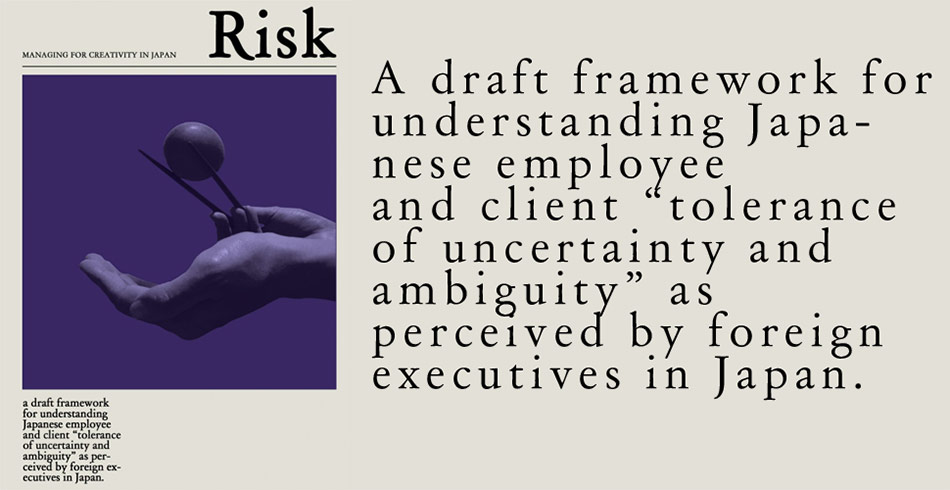
“Even if you are an established company like Unilever people still think ‘oooh no, a foreign company….even though they are one of the biggest manufacturers in the world”.(i)
Working for a non-Japanese company is risky. There is not the same cliché status and supposed safety that is associated with Japanese companies, and there is a relative lack of structure and hierarchy – “we don’t say ‘this is what you need to do, this is the checklist’….we tend to say ‘this is you time, we need you to achieve this….and what else can you come up with?” (ii) – Mentoring may need to be a bigger part of a manager’s focus in order to mitigate these perceived risks.
While this may make hiring ‘normal’ employees difficult, the positive flip side is that those that do join may be (relatively) more positively disposed towards risk (but then again, they may just be anti-social misfits).
****************************************************
This post is part of a series of excerpts from interviews with foreign executives in Japan, focusing on creativity. Excerpts have been edited for confidentiality.
We’d love to hear your thoughts and experiences in relation to this topic. Please feel free to comment directly on this site or get in touch at chris@a-small-lab.com (Chris Berthelsen)
All content on this IDEAS and DISCUSSION blog is provided by a-small-lab under a Creative Commons Attribution-Noncommercial-No Derivative Works 3.0 Unported License: You can SHARE this content as long as you CITE this work, and TELL US about your work (and send us a copy or link!). See Creative Commons for more detail
“Having a flat organization is an important factor. To help people progress in their careers and to help people feel that they are being recognized we do give people promotions and various titles but in reality it is kind of ‘everybody’ and then two or three people at the top who try to manage the chaos and keep us all going in the same direction.”
****************************************************
This post is part of a series of excerpts from interviews with foreign executives in Japan, focusing on creativity. Excerpts have been edited for confidentiality.
We’d love to hear your thoughts and experiences in relation to this topic. Please feel free to comment directly on this site or get in touch at chris@a-small-lab.com (Chris Berthelsen)
All content on this IDEAS and DISCUSSION blog is provided by a-small-lab under a Creative Commons Attribution-Noncommercial-No Derivative Works 3.0 Unported License: You can SHARE this content as long as you CITE this work, and TELL US about your work (and send us a copy or link!). See Creative Commons for more detail
“One of the key things in this country is that whether or not you are listened to depends on who you are. Your idea or your thinking might be good but if you’re lower on the hierarchy then you probably won’t be so influential.”
“If you are a really famous creative person in Japan, say if you’ve got a name and some grey hair or whatever, you may find yourself having an easier time of it than some young creative guy when you are trying to do something in corporate-land. That doesn’t mean that companies are not open to creativity but things tend to work on seniority and are very formalized.”
****************************************************
This post is part of a series of excerpts from interviews with foreign executives in Japan, focusing on creativity. Excerpts have been edited for confidentiality.
We’d love to hear your thoughts and experiences in relation to this topic. Please feel free to comment directly on this site or get in touch at chris@a-small-lab.com (Chris Berthelsen)
All content on this IDEAS and DISCUSSION blog is provided by a-small-lab under a Creative Commons Attribution-Noncommercial-No Derivative Works 3.0 Unported License: You can SHARE this content as long as you CITE this work, and TELL US about your work (and send us a copy or link!). See Creative Commons for more detail