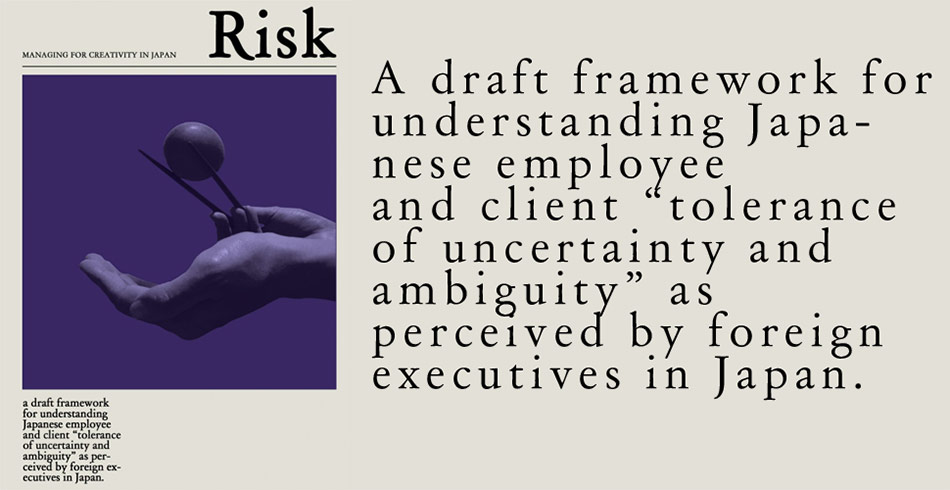
“Here they tend to take the cookie cutter and cut the same cookie…and it’s a good cookie. Once they get the design right it’s great, and it’s designed with reliability built in. Compare this with Spain where somebody would be cutting corners to try to do things faster – resulting in variability and difficulties or bad quality”.(i)
Fear, need for structure, and intense client relationships result in risk averseness which equates to consistent results which in turn form the stable base for conscientious, continual, incremental innovation (kaizen).
****************************************************
This post is part of a series of excerpts from interviews with foreign executives in Japan, focusing on creativity. Excerpts have been edited for confidentiality.
We’d love to hear your thoughts and experiences in relation to this topic. Please feel free to comment directly on this site or get in touch at chris@a-small-lab.com (Chris Berthelsen)
All content on this IDEAS and DISCUSSION blog is provided by a-small-lab under a Creative Commons Attribution-Noncommercial-No Derivative Works 3.0 Unported License: You can SHARE this content as long as you CITE this work, and TELL US about your work (and send us a copy or link!). See Creative Commons for more detail
“I would never say that the Japanese are not creative or even less creative, but their orientation and their approach is not blue sky. They have a great deal of difficulty with blue-sky thinking.”
“Look at Japan, it’s the home of more than 50 global headquarters. More than double that of either the U.S. or the U.K. This is not a country that can’t innovate or be creative. But the Japanese pull it out through kaizen and that, for me as a foreigner, has been the biggest lesson that I’ve learnt – providing the template and the formula and then ‘kaizening’ it from there.”
****************************************************
This post is part of a series of excerpts from interviews with foreign executives in Japan, focusing on creativity. Excerpts have been edited for confidentiality.
We’d love to hear your thoughts and experiences in relation to this topic. Please feel free to comment directly on this site or get in touch at chris@a-small-lab.com (Chris Berthelsen)
All content on this IDEAS and DISCUSSION blog is provided by a-small-lab under a Creative Commons Attribution-Noncommercial-No Derivative Works 3.0 Unported License: You can SHARE this content as long as you CITE this work, and TELL US about your work (and send us a copy or link!). See Creative Commons for more detail
“When you look at art and design, it’s all based on formulas and templates. There is very little Japanese art which isn’t kaizen (incremental improvement). If you study Japanese art like sumi-e or ikebana you will notice that everything is run by rules. It is a very rule-laden culture. In a corporate environment working in a field like technology for instance, ground-breaking is a difficult thing to find in Japan. The incremental improvement – taking an idea and really making it better and working it out – is their real strength.”
****************************************************
This post is part of a series of excerpts from interviews with foreign executives in Japan, focusing on creativity. Excerpts have been edited for confidentiality.
We’d love to hear your thoughts and experiences in relation to this topic. Please feel free to comment directly on this site or get in touch at chris@a-small-lab.com (Chris Berthelsen)
All content on this IDEAS and DISCUSSION blog is provided by a-small-lab under a Creative Commons Attribution-Noncommercial-No Derivative Works 3.0 Unported License: You can SHARE this content as long as you CITE this work, and TELL US about your work (and send us a copy or link!). See Creative Commons for more detail